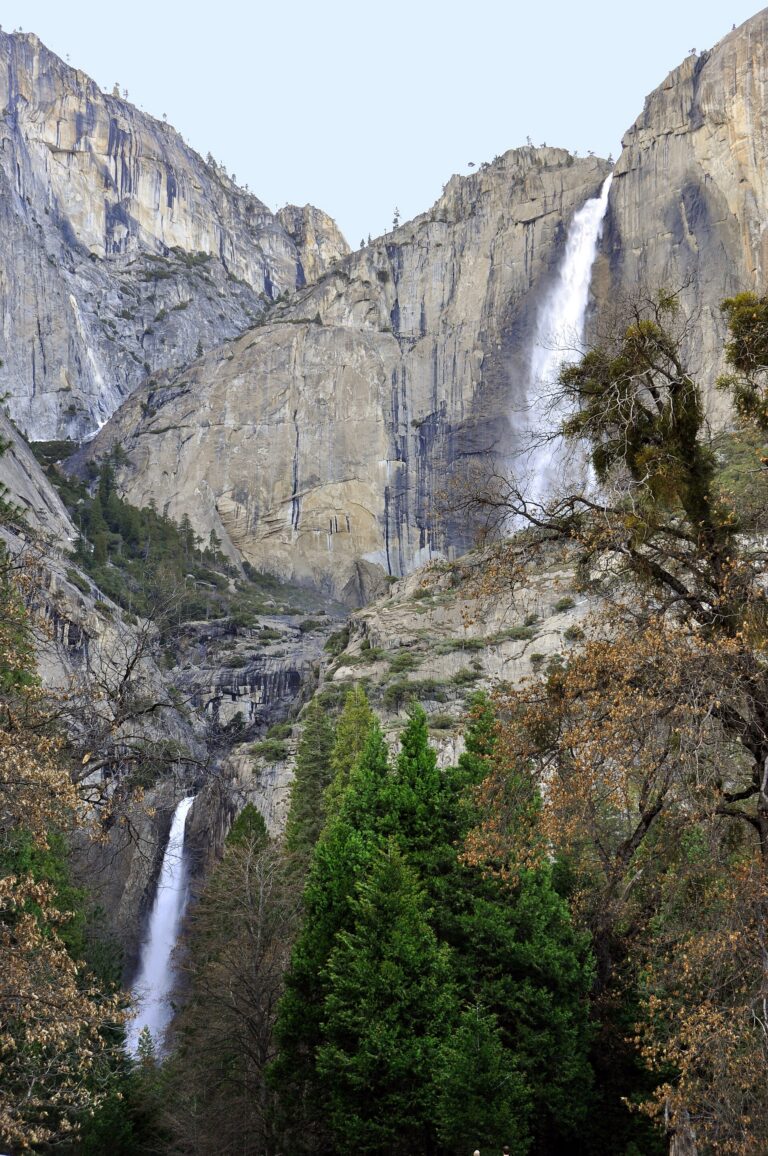
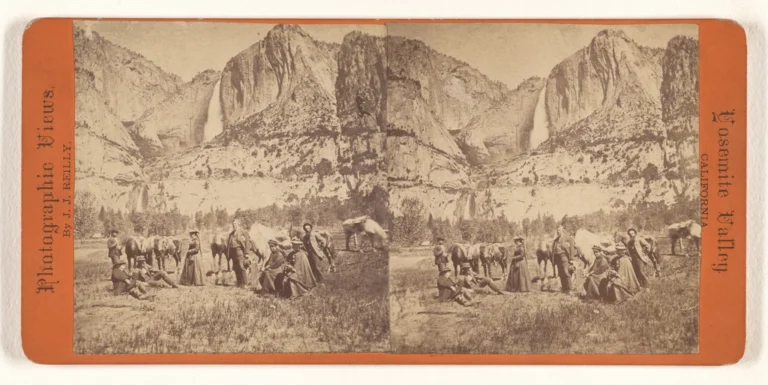
Yosemite Falls is a 2,425-foot tiered waterfall on Yosemite Creek in Yosemite Valley, California, the tallest waterfall in the state and one of the tallest in North America. It pours off the valley's north wall above Yosemite Village and is visible from much of the valley floor.
The falls
Yosemite Creek leaves a hanging valley and drops in three sections: Upper Yosemite Fall, a single 1,430-foot plunge; a middle stretch of cascades and smaller falls totaling 675 feet; and Lower Yosemite Fall, 320 feet. The total matches the survey François Matthes made in 1913, and modern lidar confirms it. The falls run entirely on snowmelt, and at peak in late spring carry around 2,400 gallons per second.
Getting there
The easy way is the Lower Yosemite Fall loop, a paved 1-mile walk with about 50 feet of elevation change that ends at a footbridge below the lower fall. The eastern half is wheelchair accessible. There is no parking at the trailhead: take the free valley shuttle to stop 6, or park at Yosemite Village or the Yosemite Falls lot.
The Upper Yosemite Fall Trail, one of the oldest in the park (built 1873 to 1877), starts at Camp 4, shuttle stop 7. Columbia Rock, 2 miles round trip with 1,000 feet of gain, gives a view over the valley, and the upper fall comes into view half a mile beyond. The full climb to the top is 7.2 miles round trip with 2,700 feet of gain, a strenuous 6 to 8 hours; Yosemite Point adds 1.6 miles. Water is available only at the trailhead.
Yosemite admission is $35 per vehicle for seven days, plus $100 per person for non-US residents aged 16 and older unless they hold an Annual or America the Beautiful Pass. No timed-entry reservation is required in 2026.
When to go
Flow runs from roughly November into July and peaks in May; by August the falls are often a trickle or dry. In winter an ice cone more than 300 feet tall can build at the base of the upper fall. In April, on cold mornings before about 9 am, frozen spray sometimes turns Yosemite Creek below the lower fall into a slush of frazil ice. On full-moon nights in April and May, high flow can produce a moonbow, most often watched from the lower fall footbridge.
On site
The best full-height views are from Cook's Meadow and the west side of the lower loop; the viewing area at the base shows only part of the falls. Expect heavy spray at peak flow and ice on the loop in winter. The rocks above the footbridge are slick even when dry, and the talus around the plunge pool has led to several helicopter rescues, so stay on the paved trail. Leashed dogs are allowed on the lower loop but not on the upper trail.
History and name
The Ahwahneechee called the falls Cholock, "the fall," and believed spirits lived in its plunge pool.
Nearby
Columbia Cascade is about 0.9 mile away, Lehamite Falls about 1 mile, Royal Arch Cascade 1.5 miles and Staircase Falls 1.8 miles.
Distances are straight-line.