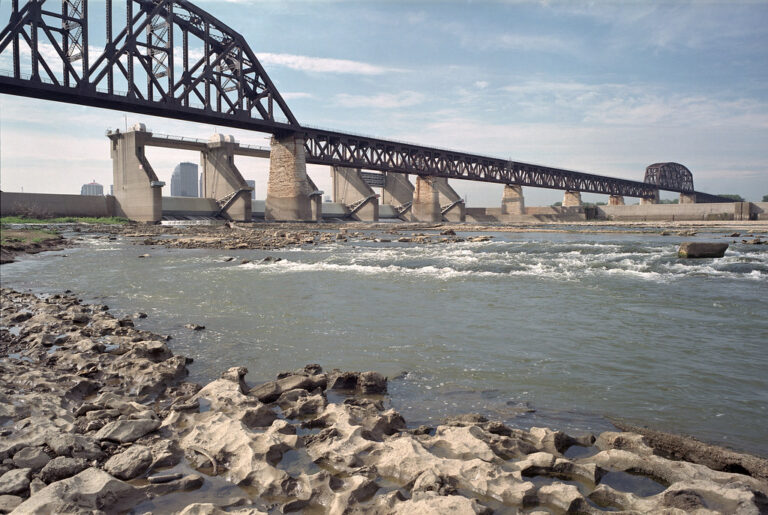
Falls of the Ohio is a reach of limestone rapids and ledges on the Ohio River at Louisville, Jefferson County, Kentucky, where the river once fell about 26 feet over 2.5 miles. The natural falls are largely gone: McAlpine Dam now spans their crest and sends most of the river through a powerhouse and a set of locks. What remains is best known for its 390-million-year-old Devonian fossil beds, which are visited from Falls of the Ohio State Park on the Indiana shore.
The falls
The site forms a series of rapids and shoals just northwest of downtown Louisville, no longer counted as a true waterfall. At low flow the ledges that formed the falls show below the dam; in spring and during rainy spells the river spills over the dam and covers them completely. The exposed rock is the main attraction today: the Indiana DNR notes that the 220 acres of fossil beds are among the largest exposed Devonian fossil beds in the world.
Getting there
Public access is on the Indiana side, at Falls of the Ohio State Park, 201 W. Riverside Drive in Clarksville, across the river from the Kentucky shore. Parking is $2; the Annual Entrance Pass covers parking only. The interpretive center charges $9 for ages 12 and up and $7 for ages 5 to 11, and children under 5 get in free. The grounds are open daily from 7 a.m. to 11 p.m.; the center is open Monday to Saturday 9 to 5 and Sunday 1 to 5, and closes on some holidays, including November 26–27 and December 24–25 in 2026.
When to go
August through October is the recommended visiting window, when the river is at its lowest and the fossil beds are most accessible. High water in spring can submerge the ledges entirely.
On site
Collecting fossils from the beds and riverbank is prohibited; the only place rocks may be taken is the collecting piles of quarry stone near the parking area. Park rules ban swimming and require dogs to be kept on a leash.
History and name
The original rapids, running from what is now downtown Louisville toward Sand Island, formed a major obstacle to river navigation. George Rogers Clark came to the falls in 1778 and later lived on the Indiana shore, where he founded Clarksville.
Nearby
Fairmount Falls is about 16 miles away, Tioga Falls about 24.3 miles and Buttermilk Falls about 28.1 miles.
Distances are straight-line.