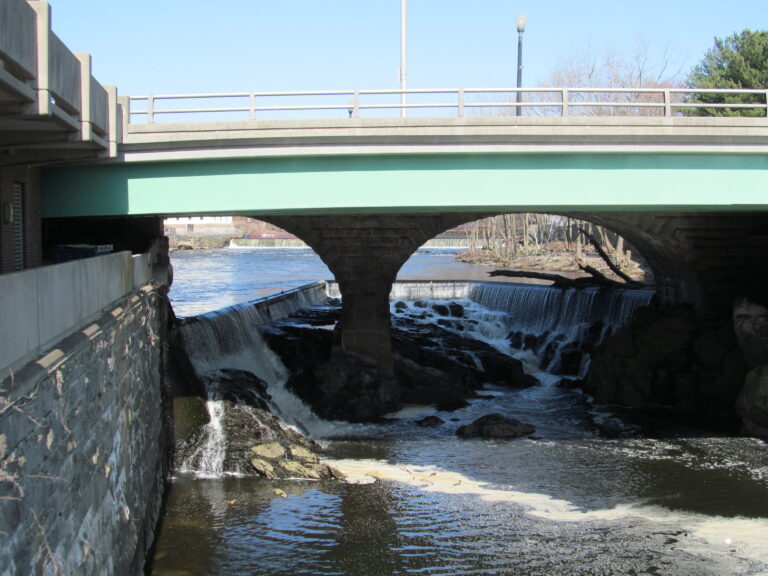
Pawtucket Falls is the last waterfall on the Blackstone River, in the city of Pawtucket, Providence County, Rhode Island, where the freshwater river turns into the brackish, tidal Seekonk River. Its water power ran the mill where cotton was first spun by water power in America, and it is now part of Blackstone River Valley National Historical Park.
The falls
Tides from Narragansett Bay push salt water up to the foot of the falls. Today the drop is controlled by the Main Street Dam, commonly identified as Pawtucket Falls: a 15-foot masonry structure built in 1896 for the Bridge Mill Power Plant.
Getting there
Parking is available at the falls, managed as part of the National Park Service historical park. The visitor hub is Old Slater Mill at 67 Roosevelt Avenue, whose grounds are open daily from dawn to dusk year-round. There is no admission fee or pass for the park.
When to go
From May 17 to October 31, 2026, rangers lead tours of Slater Mill Thursday through Sunday at 10:30, 12:30 and 2:30, with no reservation needed.
On site
A scenic viewing spot and picnic tables stand near the falls. Access to the dam or the riverbed below it is not documented.
History and name
Pawtucket comes from an Algonquin word translating to "place of the falls." For centuries Native people crossed the river on the rocks below the falls, fished there and met on trails that converged at the spot. In 1671 Joseph Jenckes Jr. built an iron forge powered by the falls, and after a bridge went up in 1713 the village grew around dams and canals feeding iron works, grist mills, sawmills, oil mills and shipyards. Moses Brown brought water-powered cotton machinery here in the 1780s, and with Samuel Slater achieved the first water-powered cotton spinning in America by 1790; the work moved into Slater Mill three years later.
Nearby
Albion Falls is about 6.5 miles away, Woonsocket Falls is about 10.9 miles away, and Lawton Valley Falls is about 22 miles away. Old Slater Mill, the park's visitor hub in Pawtucket, makes an easy pairing with the falls.
Distances are straight-line.