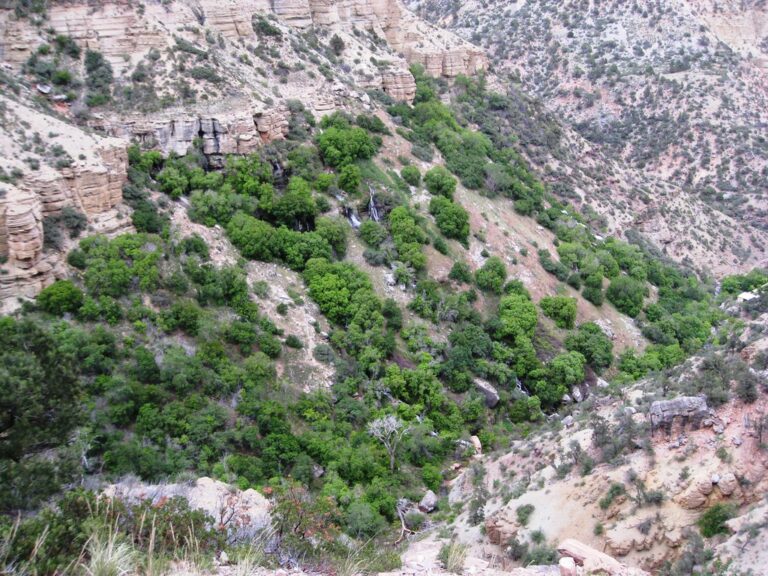
Roaring Springs is a spring-fed cascade in Grand Canyon National Park, Arizona, where water bursts from a cave in the wall of Roaring Springs Canyon about 3,000 feet below the North Rim. It is the park's main water source and, in normal years, the point on the North Kaibab Trail beyond which day hiking is not recommended.
The falls
The spring issues from a cave in the Muav Limestone, just above the point where the Roaring Springs and Bright Angel faults meet. Average flow is about 3,500 gallons a minute, rising to as much as 20,000 during floods. The water pours down the hillside near the bottom of Roaring Springs Canyon, about two miles north of Cottonwood Camp. No height has been published.
Getting there
The entire North Kaibab Trail has been closed since August 29, 2026, after flash flooding, with no estimated reopening date. A closure from Redwall Bridge to Cottonwood Campground begins October 15, 2026, for waterline construction, which ends rim-to-rim hiking.
The North Rim itself is only partly open after the Dragon Bravo Fire, started by lightning on July 4, 2025, destroyed Grand Canyon Lodge, the visitor center and the North Rim water treatment plant. In 2026 the campground reopened on June 1, but there is no lodging, and water on the rim is limited, so campers bring their own or buy it at the General Store.
When the trail is open, Roaring Springs is 9.4 miles round trip and 3,050 feet below the rim, an extremely strenuous hike of 7 to 8 hours. Admission is $35 per vehicle for seven days, plus $100 per non-US visitor aged 16 and older without an annual or America the Beautiful pass.
When to go
The spring runs all year. For a day hike, starting before 7 a.m. is advised, and not continuing past Roaring Springs.
On site
Hikers who go beyond Roaring Springs in the hottest part of the day face a much greater risk of heat illness, injury or death. On May 30, 1999, two backpackers were flown out by helicopter from Roaring Springs, one with hyponatremia and the other badly dehydrated. The pumphouse, its helistop and the water intake are closed to the public, and visitors must stay 100 feet from all water infrastructure.
History and name
Roaring Springs supplies both rims. Work on the transcanyon waterline began in January 1965; a flood in 1966 wiped out about 40% of it, and the 12.5-mile pipeline was completed in 1970. Water is pumped up to the North Rim and flows by gravity across the canyon toward the South Rim. The Dragon Bravo Fire caused a chlorine gas leak at the North Rim water plant, but the Roaring Springs water system itself was not contaminated.
Nearby
Upper Upper Ribbon Falls is about 2.4 miles away, Upper Ribbon Falls about 2.5 miles and Altar Falls about 2.7 miles, all on Ribbon Creek. Cheyava Falls is about 4.7 miles away.
Distances are straight-line.