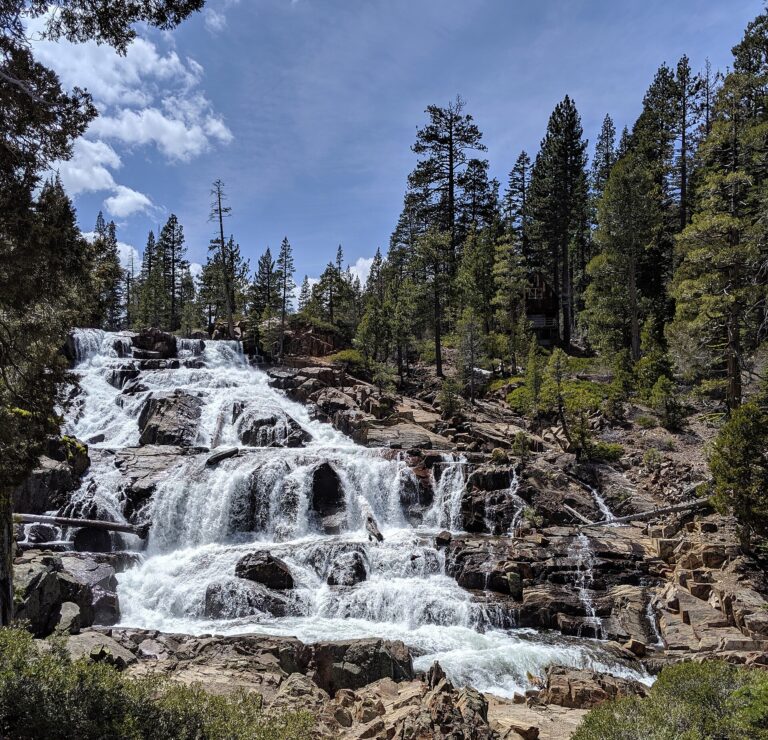
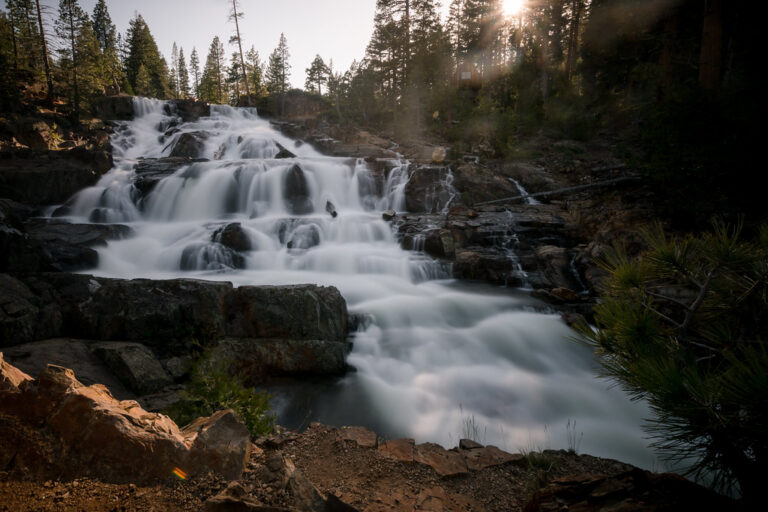
Glen Alpine Falls is a 65-foot tiered cascade on Glen Alpine Creek in El Dorado County, California, where the creek spills over broad granite shelves just above Fallen Leaf Lake in the Lake Tahoe Basin. The lower falls sit right beside the narrow road to the Glen Alpine trailhead, so they take almost no walking to see.
The falls
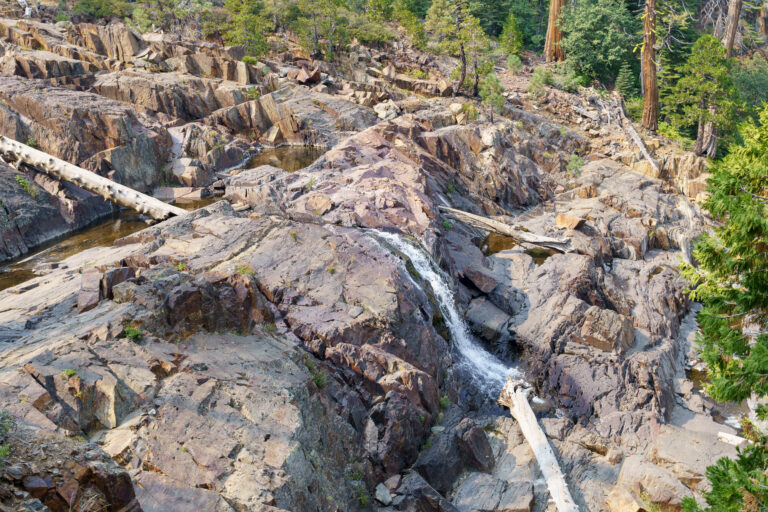
The creek drops in three steep, tiered cascades over a run of about 175 feet, spreading up to 90 feet wide across the bedrock steps at high water. The height is 65 feet; older surveys listed 73 feet, and other accounts put the lower falls at about 60 feet. Flow depends almost entirely on melting snow and rain, and by summer and autumn the falls narrow to a single channel.
Getting there
From South Lake Tahoe, Highway 89 runs north about 3 miles to Fallen Leaf Lake Road, a narrow one-lane road. Follow it about 4.5 to 4.8 miles past the lake, then turn left toward the Glen Alpine trailhead; the falls appear about 800 feet up this road after a set of switchbacks. Parking by the falls is very limited, with more space further up; spots are also found along the right side of the road after the firehouse. The falls lie within the Forest Service's Lake Tahoe Basin Management Unit.
The Glen Alpine trailhead, across from Lily Lake, continues into Desolation Wilderness, toward Grass Lake at 2 miles and Lake Aloha and Mount Tallac at 6 miles. A wilderness permit is required even for day hikes there, with self-registration at the trailhead.
When to go
The main roads to Fallen Leaf Lake are closed from October until April or May. Snowmelt brings the fullest flow soon after they open; by late summer the cascade carries far less water.
On site
The falls are seen from the roadside, with the broad ledges in full view. Both the lower and upper falls are noted as dog-friendly outings, with most Tahoe Basin trails allowing dogs on a leash. A one-mile round-trip walk reaches the upper falls.
History and name
The falls are also known as Lower Glen Alpine Falls, Big Falls and Agassiz Falls; the last was still in use as late as 1910. The trail beyond leads to Glen Alpine Springs, found by Nathan Gilmore in 1863 and later built up with six buildings designed by architect Bernard Maybeck between 1920 and 1927.
Nearby
Modjeska Falls is about 0.9 mile away, Upper Glen Alpine Falls about 1.9 miles and Susie Lake Falls about 2.7 miles, all on Glen Alpine Creek toward Desolation Wilderness.
Distances are straight-line.