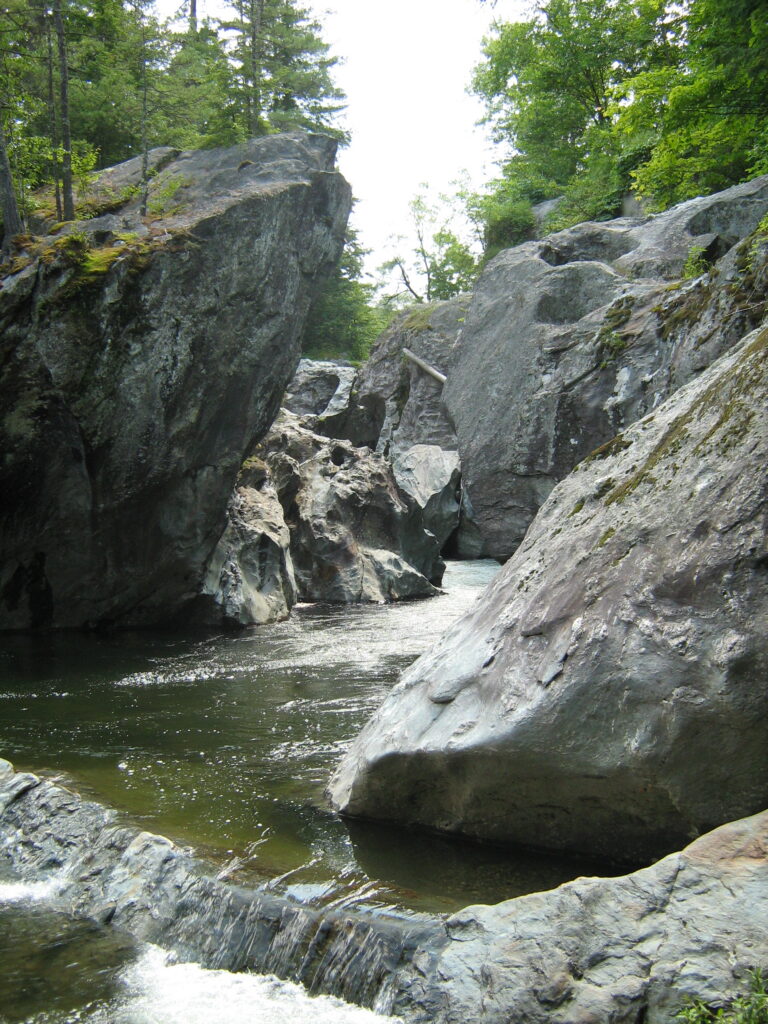
Huntington Gorge is a 25-foot tiered waterfall on the Huntington River in Richmond, Chittenden County, Vermont, where the river squeezes through a narrow slot of schist. The Vermont River Conservancy calls it the deadliest swimming hole in Vermont: more than two dozen people have drowned here.
The falls
The river has carved a string of chutes, bowls and pools into the bedrock. The flow splits: most of the water churns down through the gorge, while a smaller right-hand channel drops nearly vertically about 25 feet. That side channel goes dry at low water and disappears under floods. Earlier surveys listed 30 feet in total, with a 15-foot main plunge.
Getting there
The gorge is on Dugway Road in Richmond. From I-89 exit 11, drive US-2 east for 5 miles, then Cochran Road and 1.7 miles on Dugway Road; from exit 10, take VT-100 south and US-2 west for 9.6 miles, then Cochran Road for 0.5 mile and Dugway Road for 1.7 miles. Parking is allowed only on the marked stretches of Dugway Road closest to the river, and cars outside them are towed.
The land is private: the Richmond Land Trust owns the 4.90-acre riverside parcel, with 3,100 feet of frontage, and keeps it open to the public. After an October 2019 flood undercut Dugway Road, the town and the land trust closed the upper swimming area for the 2020 season.
When to go
May to October is the season. The gorge looks most dramatic in high water, but that is exactly when the conservancy advises staying out of it entirely.
On site
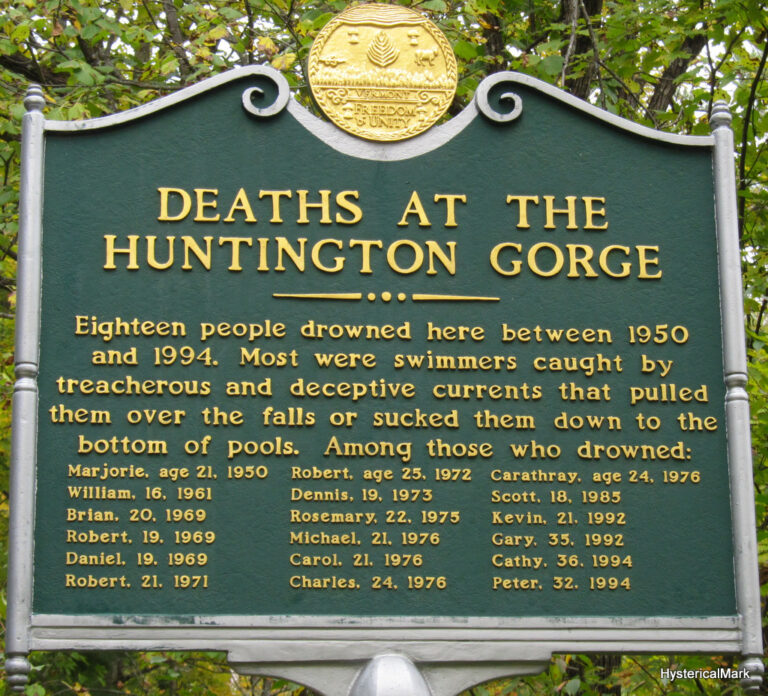
The rocks are steep and slippery, and the currents sweep people into narrow chutes clogged with trees and debris. A memorial sign at the gorge lists 18 people who drowned between 1950 and 1994; by 2016 the toll had reached 26, and it is now counted at over 40. On May 8, 1992, 21-year-old Kevin Brown drowned here, and four days later Vermont State Police diver Gary Gaboury died in the same chute. The conservancy recommends swimming somewhere else. Dogs are allowed on a leash, and there is no cell service.
History and name
A mill worked the gorge from at least 1802. In 1903 the Richmond Light and Power Company turned the site to generating electricity, and power lines carried it to Richmond Village until the plant closed in 1910. The gorge has since returned to its natural state.
Nearby
Duck Brook Cascades and Honey Hollow Falls are each about 3 miles away, and the Bolton Potholes on Joiner Brook are about 4.6 miles.
Distances are straight-line.