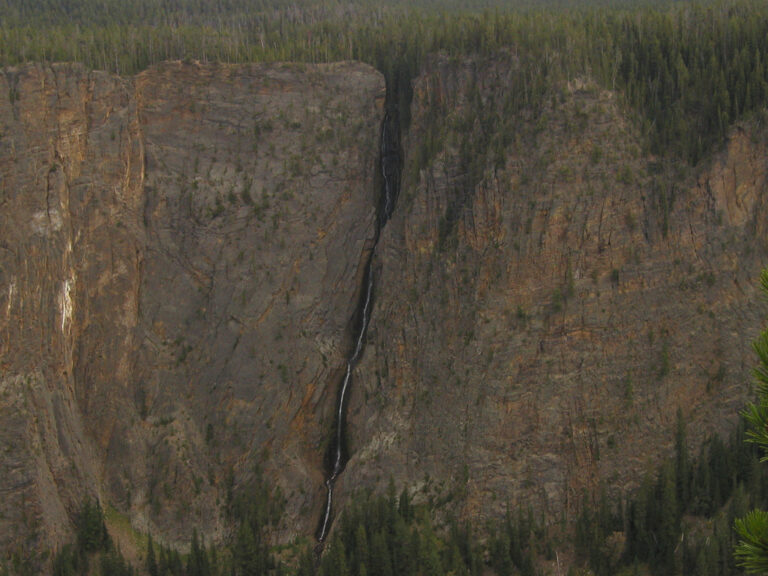
Silver Cord Cascade is a slender, roughly 520-foot tiered waterfall on Surface Creek in Yellowstone National Park, Wyoming, falling from the south rim into the Grand Canyon of the Yellowstone. For more than a century it was billed as a 1,200-foot fall; modern lidar shows it is less than half that.
The falls
Surface Creek drains Ribbon Lake and spills over the canyon rim in four closely spaced leaps. A lidar survey measured the drop at about 520 feet; the long-cited figure of 1,200 feet is a physical impossibility, since Ribbon Lake sits only a little over 1,000 feet above the river and the falls end less than halfway down. The stream is small, so the cascade reads as a thin silver line against the canyon's yellow rock.
Getting there
The classic view is from across the canyon. The Seven Mile Hole Trail starts at the Glacial Boulder pullout on the Inspiration Point road, and for its first 1.5 miles runs near the north rim with views of the cascade; the full trail is a strenuous 10-mile round trip that drops more than 1,000 feet to the river.
To stand near the brink, take the Ribbon Lake Trail from the Upper Falls Viewpoints parking area on South Rim Drive, 2.3 miles south of Canyon Junction: 5.8 miles round trip. The falls are hard to see from the rim beside Ribbon Lake; a promontory a few hundred feet east gives a view down.
Yellowstone admission is $35 per vehicle for seven days, plus $100 per person for non-US residents aged 16 and older unless they hold an Annual or America the Beautiful Pass. The roads to Canyon open in spring (projected April 17 from Norris and May 1 from Bridge Bay in 2026) and close October 31.
When to go
The Canyon area trails are hiked in summer and fall. Surface Creek runs off snowmelt, so the cascade is fullest earliest in the season and thins through summer.
On site
The rim near Ribbon Lake has sheer, unfenced drops of around 1,000 feet. The Ribbon Lake route passes the Clear Lake thermal area, and the Seven Mile Hole Trail passes hot springs; off-trail travel is prohibited in thermal areas. Grizzlies frequent the area: carry bear spray, hike in groups of three or more and stay at least 100 yards from bears. Dogs are not allowed on trails.
History and name
Members of the 1870 Washburn Expedition named it Silverthread Falls; Superintendent Philetus Norris renamed it Sliding Cascade in 1883, and Arnold Hague's geological survey settled on Silver Cord Cascade in 1885. Even in 1870, expedition member Cornelius Hedges dismissed reports of 1,000-foot falls in the canyon as exaggerations.
Nearby
Lower Yellowstone Falls is about 2.3 miles away, Red Rock Cascade about 1.9 miles and Castle Ruins Falls about 0.9 mile.
Distances are straight-line.